About cultural differences...
When you come to India from Europe you will most likely experience a culture shock. Crazy traffic, noise, crowded streets, eating rice with fingers, Indian toilets etc. But if you are open minded you will adjust and enjoy the differences. The best way to get to know the culture is to spend time with local people.
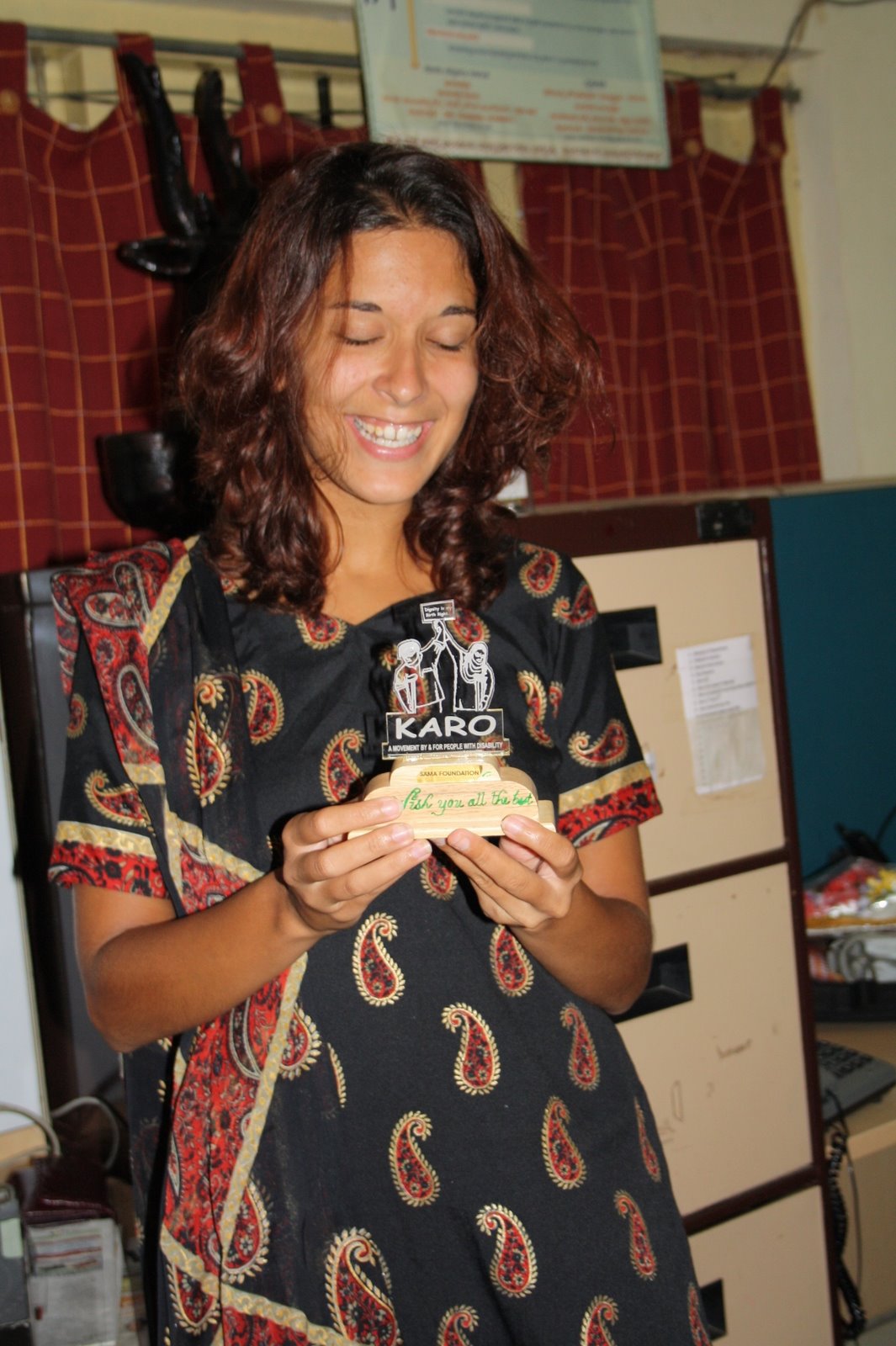
In India you see bright, beautiful colours everywhere and the streets are filled with sounds of traffic, vegetable sellers etc.. When going back to Europe one will most likely feel like somebody switched off the volume and the contrast of colours. There are certain rules you should follow if you want to be accepted by the community. As a woman, you should not wear clothes that reveal too much. When working as a volunteer, I think it is best to wear chudidar or some other Indian clothes. In India you can see men smoking everywhere, but if a woman smokes she will get many disapproving looks and will not be respected. The same goes with alcohol.
When entering a house you should usually remove your footwear. Do not stand in the doorway, because it is thought to be something that only beggars would do. It is also disrespectful to show your foot soles to an elderly person – probably because the streets are very dirty. The waste problem is worsening in India and you can see piles of garbage almost everywhere, which is due to the large population and attitudes towards littering. Children learn at young age that it is okay to throw garbage on street, but there is also a lack of garbage bins.
Traffic is its own chapter. Crossing the road can take a long time and the cars do not even slow down when you are standing in the middle of the road. In the city area you can really feel the pollution and one of the main reasons might be the large number of autorickshaws. When you are a foreigner, the autodrivers will usually try to cheat you every time, but do not let them charge you extra. Buses are the cheapest way to travel and you can reach almost any place by bus. But these vehicles are sometimes very crowded and do not drive at night either. At night time you should be very careful - especially if you are a woman. I recommend carrying a flashlight with you, because in India there are power cuts almost every day.
The climate varies quite a lot depending on your whereabouts in the country. In Bangalore, the climate is pleasant – not too hot and not too cold.
One thing I will not miss when I go back to Finland is washing clothes on the bathroom floor; nowadays I really appreciate washing machines! In Indian houses showers are a very rare sight, which means that you bathe with a bucket and a jug – not too complicated. Western toilets are not common either, so one should adjust using Indian toilets.
On the streets you see dogs and cows going through the garbage and eating whatever they can find. The number of stray dogs is very high in India and sometimes it causes problems. The cow is a sacred animal for Hindus so cows are seen wandering the streets every where except in the very city center. Usually you cannot find beef in Indian restaurants or shops, only in some rare places where the Christian and Muslim population is high. Many Hindus are strictly vegetarians, but some eat chicken, mutton and pork. Indian food is, for the most parts, very tasty and can also be divided in different
categories, like North Indian, South Indian etc. Indian people eat three hot meals a day and have rice at least at one meal. Rice, like most dishes in India, should be eaten with fingers using your right hand only. It might feel strange at first not to use fork and knife, but you get used to it quite soon – you are using more of your senses and feel closer to food. I am sure I will miss that back in Finland.
-Karoliina-
Yours and mine - (indian family)
In some places there doen’t seem to be a great difference in the belonging of things to certain people. Especially under friends it is usual to use the shampoo, the pen, scribbling pad or even eat the lunch. Nobody will be angry if there is nothing left afterwards, the pen is broken or you have to buy lunch for your own. This is friends service included. One da it will go the other way around. Same thing with money. If somebody has, he will spend it on friends and not only small amounts. You are happy to provide something to your friend…
The other side of the medal is when some foreigners are not used to this behaviour…. I had to learn with around 10 lost pens, that I have to keep it close to me if I want to write something one day. Also the matter of providing something can be discussed. In some peoples mind seem to be the permanent image foreigners are swimming in money, in other places I have to fight that I can pay something back…..
My experience says that this sharing comes from the type of family in which most idians grew up. Big families, easily with ten member living together in a house or same area. Everybody helps each other and cousins of same age are called brother, because they grow up as close as siblings. There is not a big difference between your and my child and also neighbours live close to each other. More earning families help others out with marriage expenses and send regular a lot of their salary to parents at home. Therefore the family supports you if you have problems, is ready to sleep in hospital with you and gives you strength. The family is normally most important to every Indian.
Family in India
This is supposed to be a very big chapter, because here the family is normally the middle of everyone’s life.
Before I start, I have to repeat, that this is my experience in Bangalore and based on what people told me. It is supposed to be the average Indian society I describe.
Let me begin with the childhood. Children are treated like small gods, they seem to be allowed to do everything and get everything they want. I saw this in some families, of cause there are also parents who give the usual restrictions and borders to the children and there are those who don’t care much. The small girls wear usually grant, (absolute kitsch), cute dresses and some put a bit make up every day. The boys are the princes in the house and the parents provide only the best they can afford. Children are always welcome, also on working places, but still there is rarely a place only for them. Big grounds are occupied by cricket playing teens and men and there is no space in a big town for playing grounds. So the children play on the street, all together in the neighbourhood.
When the child grows the girl learns how to maintain the household and cooking. She helps her mother and supports and learns for her future life as house wife. The boys you see more often hanging around in the streets, playing cricket. The marriage time depends very much on the community the family lives in. In villages it is for girls even before 18, 18 or latest 20. In the city it is more around 24-26, in higher classes after the woman finished the full education. The man is often 3 years older, also up to ten years in the village side. Often the girl’s education stops when married, the boy’s goes on until he gets a job.
Marriage
When I explain about the Indian family I also have to explain the marriage procedure. It seems to be the most important event in every Indians life. The mother and grandmother start looking for a fitting husband, a wife. Many things have to be considered. The caste is important (other religion also means different caste), the money of the family, beauty of the woman, age, health, how much dowry they can pay and sometimes much more marry-important thoughts. In this planning the child, man and woman, usually doesn’t intervene, isn’t allowed to. Some things can be said, plans postponed, one or two applications not be accepted but finally nearly everybody agrees.
Usually no side had any close relationship before marriage. It is strictly forbidden, also because it is very important for both sides, that the partner is virgin. Love marriage is also rare, lovers often have to accept that this time will be over when plans come up from family side.
The wedding gets organised and lakhs of rupees are spend, even low earning families spend incredible much money on the marriage. Either it is the dowry or the expence for the actual event. For example I heared about a family who spend 2 lakhs (200.000Rs) for their daughters marriage. The parents are not earning, mother housewife, father retired, the daughter goes to college. Only the son is earning around 5000rs per month.
Weddings vary a lot. It depend on the money, the family origin and religion. But I can tell best about Hindu marriages. It begins with the invitation of everybody barely known. Even all friends and colleagues of brothers, sisters and cousins are welcomed. Often the actual marriage takes place in the early morning, normally only with close family. This is not so interesting for the rest of the community. In the night before is “Reception” when good food is served to hundreds of visitors. Usually in the marriage halls are two rooms. In one are long fixed tables and benches where guests sit in long rows and eat. When they finished their meal, they go to the reception hall. In the front is a stage, beautiful decorated with flowers and colourful cloth. In the middle are two thrones for the couple. There they receive presents from the guests, make a photo or are often even filmed. Next day lunch time is the wedding for the masses. Pooja and blessings from the family and guests are preformed, the thali is tied. The thali is a long necklace with a golden coin in the middle. The man ties it around the neck of the woman who wears it her whole life as a sign of marriage. Loud life music is also played that time, maybe to cover the conversations of the guests who seem to be very less interested in the rituals. After it s finished everybody rushes out of the hall to receive again some food, this time lunch and more basic then the night before. The bride is dressed in different sarees for both days. Very grand for the reception, more traditional but not less expensive in silk saree for the marriage. She also wears lots of jewellery. Painted hands and arms, bangles, necklace, earrings, a chain from the earring to her hair this is covered with flowers, one golden dolore on her forehead, food chains. The man wears best shirt and pants, a golden watch and often a traditional hat.
-Mareile-